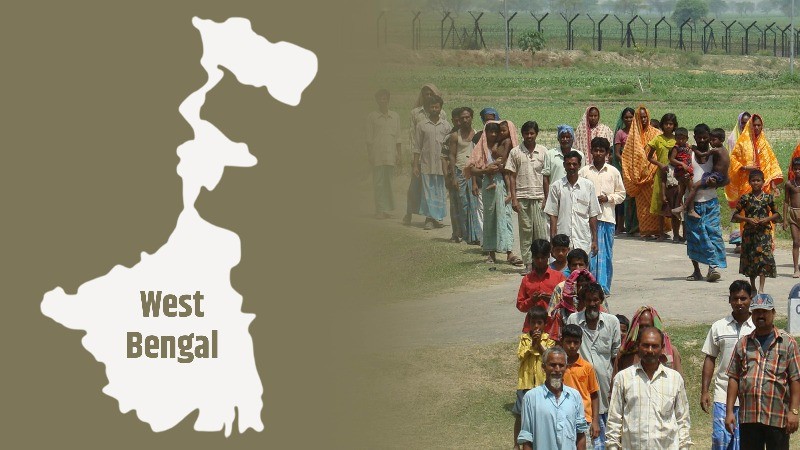

Ever since India united in 1947, a gradual, silent transformation has progressed in West Bengal, the land of the rich Sunderban delta, and from where the Ganges makes its way to the ocean. And its demographic, a shift in population dynamics that has changed the social and cultural landscape of the region. Census figures reveal it all. In 1951, the Hindus comprised about 78.45% of the population, while the Muslims were 19.85%. Decades later, in 2011, the Hindus constituted 70.54%, while Muslims were at 27.01%. In a state of 91 million people, there were 24.6 million Muslims. With the ongoing illegal migration and rising fertility rates, it is estimated that Muslims may reach 30-35%.
The demographic transformation is highly visible in border regions, which bear the impact due to their proximity. Murshidabad, which was once absorbed in traditional Bengali culture, now has a 66.27% Muslim population, while Malda accounts for 51.27% Muslims, North 24 Parganas at an average of 26%, with certain pockets even surpassing 60%.
| Districts | Muslim population |
| Murshidabad | 66.27% |
| Malda | 51.27% |
| N24 Parganas | 26% |
| Uttar Dinajpur | 47.07% |
| Cooch Behar | 25.91% |
| Nadia | 25.16% |
Bangladeshi infiltrators are also behind recent acts of violence, such as the protests in Murshidabad over the Waqf Amendment Bill. Moreover, this paradigm shift has changed the entire lifestyle for the people in Bengal, especially the Bengali Hindus. There is a growing concern about the condensed population of Hindus due to a political, economic, and cultural shift. In certain areas like Kaliganj, which was once a Hindu-majority seat, today, the Muslims account for 58.5%. Locals still recall how their festivals were stopped, and lands were captured.
It has always been the border, a 4,096 km stretch that couldn't really bar or divide. A large part of it is riverine, etched through rivers like the Padma and the Ichamati, as well as unfenced, which serves well for border crossing beneath the dense waters and behind green cover.
The origin, of course, dates back to the Partition in 1947, when Bengal was divided into West Bengal (the Hindu-majority region) and East Pakistan (the Muslim-majority region), which later became Bangladesh. Economic hurdles and communal tensions began soon after in East Pakistan, prompting people to seek refuge on the other side of the border.
It all intensified later, with a massive displacement during the Pakistan Liberation War in 1971. Hindu refugees went on to seek formal assistance, and the Muslim population tried to assimilate into the Muslim-majority villages. They found new ways of penetration through the unguarded rivers and escaping patrols with the help of organised networks.
What was once an opportunistic crossing turned into a well-organised racket. Trafficking continued from both sides, with Rs 7000-10,000 charged for a single head. The amount crossed lakhs when it came to someone fleeing criminal charges. They looked for loopholes, as the Intelligence Bureau (IB) officials call it, a "well-oiled machinery." After arrival, they found temporary refuge somewhere, and if caught, they offered bribes to policemen and local politicians.
There have been many real cases that reveal the level of this entrenchment. Take the case of Abdul Majed, who was convicted of assassinating Bangladesh's founder, Sheikh Mujibur Rehman. He took refuge in Kolkata for 23 long years, with an Indian passport and a local marriage before his arrest in 2020.
After 1971, the penetration has been mainly of economic migrants, poor farmers, and labourers who could easily become a part of the informal workforce of Bengal. Then, since the 1990s, as Bangladesh gained stability, the influx shifted to criminals and radicals, who were joined by Rohingyas of Myanmar in 2017.
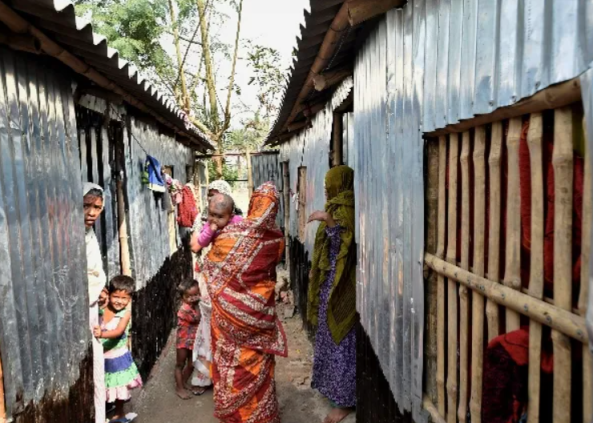 A Rohingya household in South 24 Parganas (Image source: PTI)
The infiltrators didn't just restrict themselves to finding a place to live and work; they soon began gaining a foothold, with economic power and political protection. They found a stronghold in the informal sectors such as fish farms, street vending, and other small trades. This impacted the Hindus, who were displaced from their ancestral livelihoods, where they worked as farmers and artisans.
The Rohingyas who arrived just seven to eight years ago, today, aid local political figures in the state. Now, it was beyond work and labor; they started controlling resources. With the economic shift, there came cultural erosion too. Their population increased significantly, and they began objecting to Hindu festivals, followed by harassment and unjust control. This led to Hindus selling lands and moving elsewhere. Signs of radicalisation were visible throughout, with madrasas preaching intolerance, involvement of external influence, and appeasement turning them aggressive.
The economic racket exposed by the Enforcement Directorate (ED) raids in 2019 revealed that these operations involving illegal migration generated Rs 5000 crore globally, which includes Rs 3000 crore from fake documents and Rs 1000 crore from entry fees. Trafficking of girls began on a large scale, with nearly 200 cases reported every year.
The effects are no longer restricted to Bengal alone; they now cover neighboring states as well, including Odisha. Infiltration has also extended to government structures, where administration is not only tolerating it but even supporting it through forged identities. Fake Aadhar cards and passports are offered additionally with offers such as "Family discount". The ruling parties, such as Congress, TMC, and Left, have long supported this, enabling migrants to thrive as Citizens of India.
An erosion of sovereignty continues, with amplified political polarisation...staging elections with demographics dictating it all.